

A sewer problem can put a Tampa Bay home on hold fast. Slow drains, recurring backups, sewer odors, and wet spots in the yard all raise one urgent question: will repairing the line mean digging up the lawn, driveway, or landscaping? This trenchless sewer comparison explains how the main repair options work, where each one fits, and what should guide the decision for your property.
Trenchless repair can reduce excavation, but it is not a one-size-fits-all answer. The right method depends on the condition, material, route, and depth of your sewer line. A camera inspection and an honest assessment should come before any recommendation.
Trenchless Sewer Comparison: The Three Main Options
Most residential sewer repairs fall into three categories: cured-in-place pipe lining, pipe bursting, and conventional excavation. Each can solve a real sewer issue. The difference is how the damaged pipe is restored or replaced.
Pipe lining: Creating a new pipe inside the old one
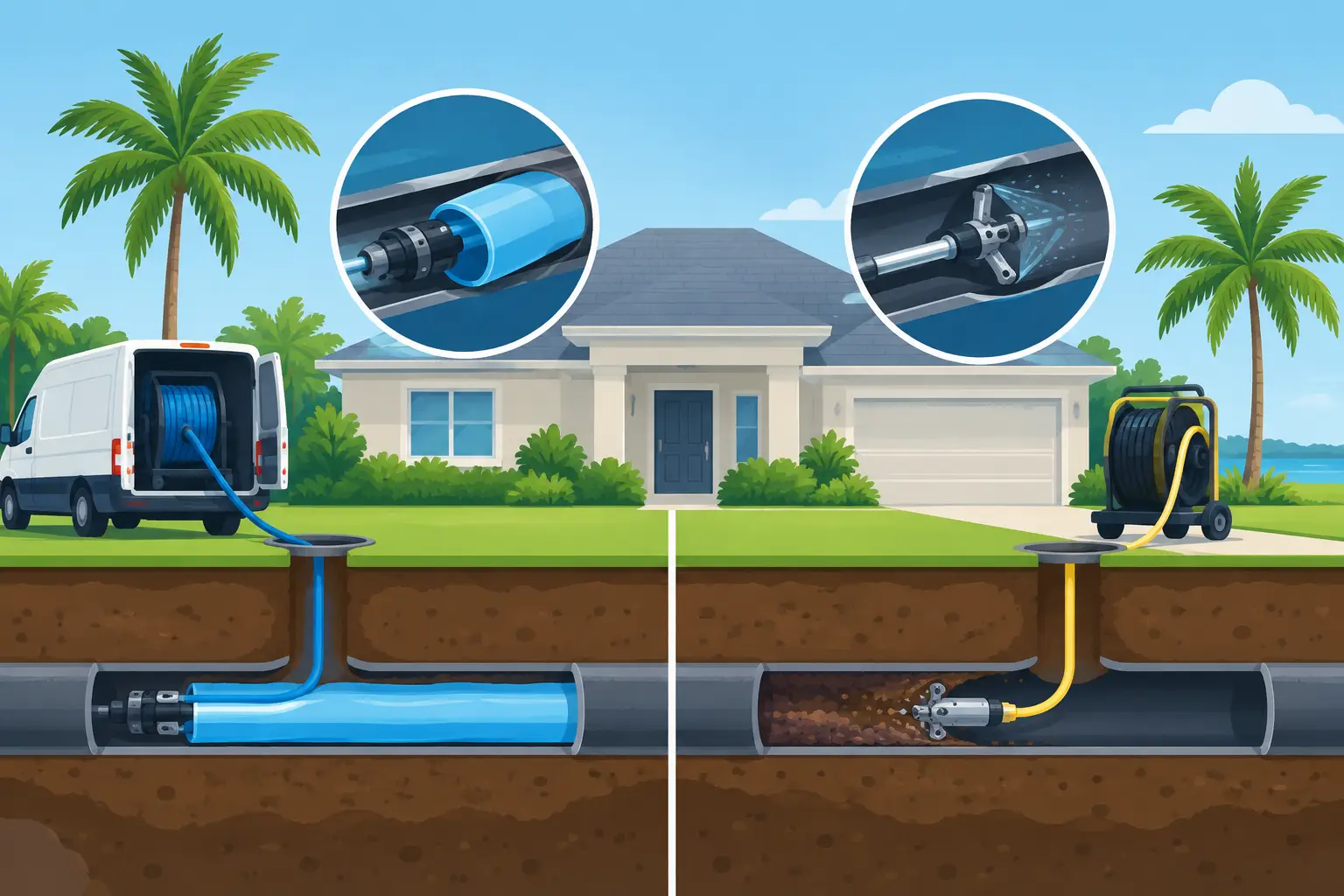
Cured-in-place pipe lining, often called CIPP or epoxy pipe lining, rehabilitates an existing pipe from the inside. A technician cleans the sewer line, inserts a resin-saturated liner, inflates it into place, and allows the resin to cure. The finished liner becomes a smooth, durable pipe within the original pipe.
For many homeowners, the primary benefit is less disruption. Access may be possible through a cleanout or a small opening, so there may be little to no need to excavate long sections of yard. That can be especially valuable when a sewer line runs beneath mature landscaping, patios, pool decks, or driveways.
Pipe lining works best when the existing line is mostly intact and maintains its general shape. Cracks, leaking joints, minor root intrusion, and some corrosion are often good candidates. The existing pipe must be thoroughly cleaned first, and the line needs enough remaining structure for the liner to be installed correctly.
The trade-off is that lining slightly reduces the interior diameter of the pipe. In a properly sized residential sewer, that reduction is usually manageable. However, a severely crushed, collapsed, misaligned, or heavily bellied pipe may not be a lining candidate. A liner follows the path that is there, so it cannot correct every slope or structural problem.
Pipe bursting: Replacing the pipe underground
Pipe bursting replaces the old sewer line instead of lining it. A bursting head is pulled through the existing pipe, breaking the old material outward while drawing a new pipe into place behind it. The new line is commonly high-density polyethylene, a flexible and durable material with fused joints.
This option is often useful when the existing pipe has extensive damage that cannot be rehabilitated with a liner. It can address brittle cast iron, deteriorated Orangeburg, badly cracked clay pipe, and certain collapsed sections. Because the old line serves as the route for the replacement, pipe bursting can still avoid the long open trench associated with traditional sewer replacement.
It does require excavation at access points, usually near each end of the line. The amount of digging is often far less than a full trench, but homeowners should understand that “trenchless” does not always mean no digging at all. Trees, utility lines, nearby structures, and the pipe’s route can also affect whether pipe bursting is appropriate.
Pipe bursting is generally a stronger choice than lining when a full replacement is needed but the property makes large-scale excavation undesirable. It may not be suitable where the line is tightly surrounded by sensitive underground utilities or where there is not enough room for access pits and equipment.
Conventional excavation: Direct access and full correction
Traditional excavation exposes the sewer pipe by digging a trench. It is the most disruptive approach, but it remains necessary in some cases. When a sewer line has major sagging, improper slope, multiple collapsed sections, or a route that needs to be changed, direct excavation gives the repair team full access to rebuild it correctly.
Excavation can also be the practical choice for shallow, easily accessible lines in open yard areas. If there is no driveway, pool deck, or extensive landscaping to protect, the savings from avoiding a trench may be smaller than expected.
The downside is restoration. Lawn, irrigation, shrubs, fencing, walkways, and hardscape may need to be removed and repaired after the sewer work is complete. The repair itself may be straightforward, but the impact on the property is a meaningful part of the total project.
How to Compare Cost Beyond the Initial Estimate
A trenchless repair can cost more per foot than digging, particularly when specialized equipment and materials are required. Yet the lowest repair estimate is not always the lowest total cost. A conventional trench may require separate expenses for concrete replacement, landscape restoration, irrigation repair, paver work, or replacing a damaged driveway section.
The most useful estimate looks at the whole job. Ask what is included for diagnosis, permits, access, sewer repair, testing, cleanup, and restoration. If a proposal compares a trenchless solution with excavation, it should explain what property disruption each method is likely to cause.
Several factors influence pricing. The length and depth of the line matter, as do pipe diameter, material, the number of bends, access conditions, local permitting, and whether the repair crosses beneath concrete or other improvements. A line beneath a landscaped side yard presents a very different project from a deep line running under a garage slab.
Financing can also make a major sewer repair easier to manage. Still, homeowners should choose the repair method based on long-term suitability first, then consider payment options and scheduling.
What a Sewer Camera Inspection Should Reveal
No reputable recommendation should rely only on symptoms. Recurring clogs can come from a local blockage, roots, grease buildup, a damaged main line, or even an issue farther downstream. A sewer camera inspection helps identify the actual cause and shows whether trenchless methods are viable.
The inspection should document the pipe material, approximate location and depth, cracks, offset joints, intruding roots, corrosion, standing water, and any collapse or deformation. It should also help determine whether the sewer line has enough slope to drain properly.
For older Central Florida homes, cast-iron drain lines can be a particular concern. Over time, internal scaling and corrosion can narrow the passageway, while cracks and failed joints can allow roots and groundwater to enter. In some cases, thorough cleaning followed by lining can preserve the route without disturbing finished areas of the property. In others, the pipe condition calls for replacement.
A camera inspection does not just support the repair decision. It gives you a baseline record of what was found, where it was found, and why one solution is being recommended over another.
When Trenchless Repair May Not Be the Right Choice
Trenchless methods offer real advantages, but they are not automatically the best choice. A pipe with severe bellies, meaning low spots where waste and water collect, may need to be regraded. A fully collapsed line may not allow equipment to pass through. Extensive offsets, an inaccessible route, or utility conflicts can also make excavation the more reliable plan.
Be cautious of any contractor who promises a trenchless solution before inspecting the line. The better answer may be, “It depends on what the camera shows.” That is not hesitation. It is the professional approach to protecting your home and your investment.
Homeowners should also ask whether the proposed repair addresses the full problem. Fixing a single damaged section can be appropriate, but if the remaining pipe is near the end of its service life, a spot repair may only postpone the next failure. The best scope balances current needs, pipe condition, budget, and how long you plan to stay in the home.
Questions to Ask Before Approving Sewer Work
Before moving forward, ask whether the contractor has identified the exact failure and whether you can review the camera findings. Ask which trenchless option is being proposed, why it is suitable for your pipe, how many access points are needed, and what restoration is included.
It is also reasonable to ask about permits, warranties, final flow testing, and what happens if additional damage is uncovered. Clear answers help prevent surprises and make it easier to compare proposals fairly.
For Tampa Bay homeowners, a sewer decision is rarely just about a pipe. It is about protecting the yard, the home, and the routines that depend on working plumbing. ACS Home Services can assess the line, explain the practical options, and help you choose a repair path that makes sense for the condition of your system and your property.